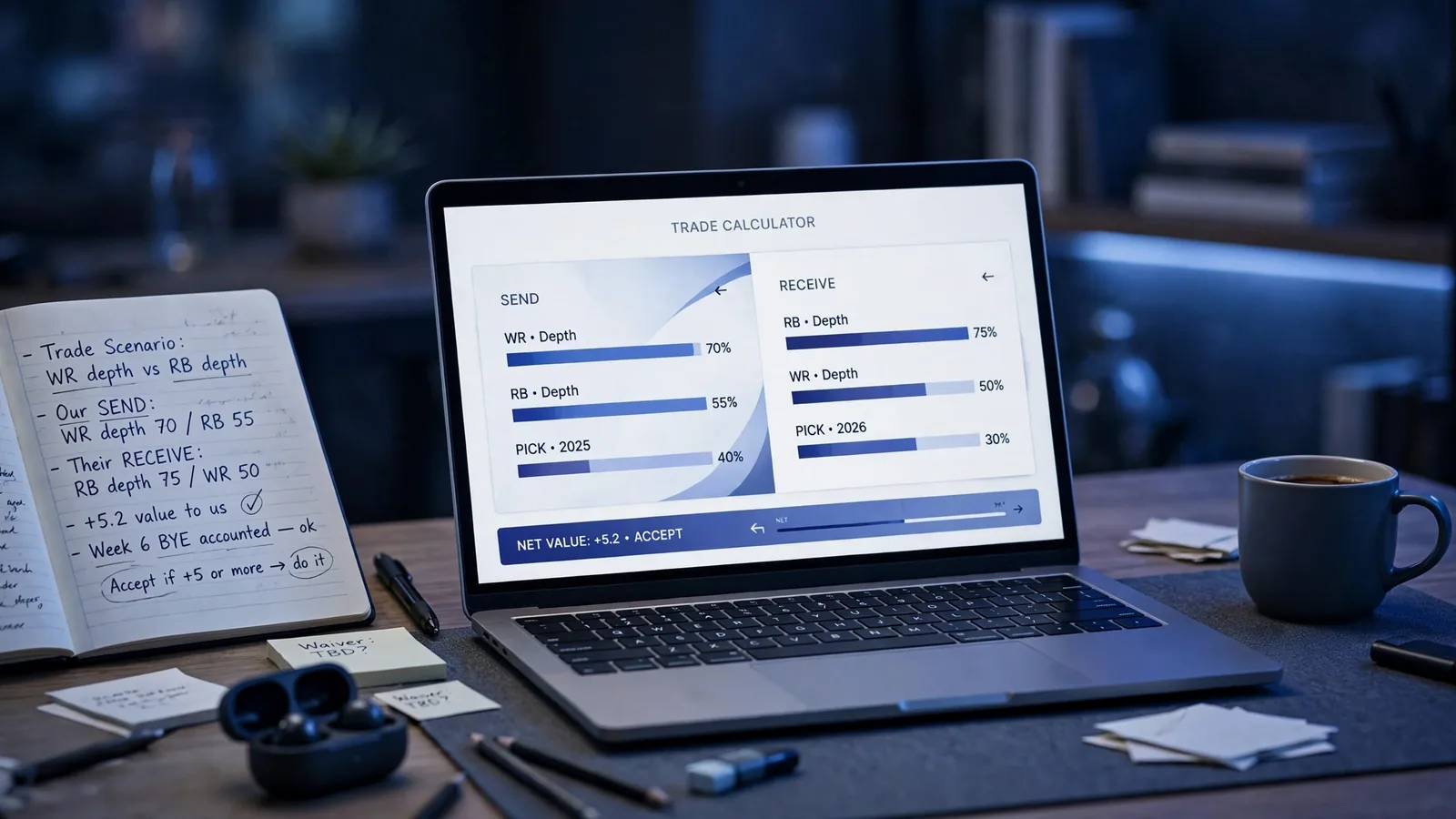
What a Dynasty Trade Value Actually Is
It is not a salary, not a draft cost, and not a prediction of next week's points. It blends three things that pull in different directions:
- Production — what the player scores, and how reliably.
- Future — age, contract situation, team context, and how many good years are plausibly left.
- Scarcity — how hard the position is to replace in your league's format. A quarterback in Superflex is scarce. The same quarterback in 1QB is not.
The Four Ways Values Are Built
Most dynasty sites build values one of four ways. None of them is "the truth". Each has a strength and a blind spot, and knowing which one you are looking at explains most disagreements.
1. Crowd Votes
Sites like KeepTradeCut ask thousands of managers a simple question, over and over: would you rather have Player A or Player B? The answers become a ranking, and the ranking becomes values.
- Strength — it captures what real managers would actually do, including hype, fear and league trends a formula would miss.
- Blind spot — crowds herd. A big week moves a player too far, too fast, and a quiet veteran drifts down even when nothing about his situation changed.
2. Real Completed Trades
Sites like FantasyCalc and Dynasty Dealer build values from trades that actually happened — millions of them in FantasyCalc's case, and hundreds of thousands of real Sleeper trades refreshed every 12 hours in Dynasty Dealer's case.
- Strength — this is revealed preference, not opinion. If managers keep paying two firsts for a player, that is what the market will bear.
- Blind spot — completed trades are a biased sample. Desperate teams overpay, contenders pay a premium at the deadline, and rebuilding teams sell at a discount. The average trade is not the fair trade.
3. Models
Model-based sites — NextDyne is the clearest example — publish a formula: production weighted across recent seasons, an age curve, draft capital, and format adjustments (for example, a Superflex quarterback bump and a tight end premium bump). The formula runs the same way for every player.
- Strength — it is consistent and explainable. You can see why a 27-year-old running back is falling and a 23-year-old receiver is not.
- Blind spot — a formula only knows what it is told. A coaching change, a new quarterback, or a role change that has not shown up in the stats yet will not move the number until the production does.
4. Editorial and Expert Values
Some sites set values by hand — an analyst or a small team updates a chart, often weekly, based on film, news and judgment.
- Strength — a human can react to news the same day, before any vote or trade data catches up.
- Blind spot — it is one opinion, or a few. Two experts can watch the same player and disagree by a round of draft capital, and there is no data trail to audit.
Most calculators you will use blend at least two of these. When two calculators disagree, the first question is not "which one is right?" — it is "which method is each one using?"
Why Two Calculators Disagree on the Same Player
Take a hypothetical example — not a real player, and not a real value. Imagine two calculators both value a 26-year-old wide receiver. One says 100 points. The other says 82.
That 18-point gap does not mean one of them is broken. It usually means one of these five things:
- Different formats. One is set to Superflex, the other to 1QB. Or one has tight end premium on and the other does not.
- Different data windows. One weights last season heavily; the other averages three seasons. A player who broke out last year looks very different under each.
- Different age curves. Running backs fall off a cliff in most models around age 27–29. Receivers hold value longer. A model with a steep age curve punishes an older player that a crowd-vote site still loves.
- Different recency. A crowd-vote value moves within days of a big game. A trade-data value moves only when enough real trades happen. A model value may not move at all until the next production update.
- Different baselines. Values are relative. If one site's top player is worth 10,000 and another's is worth 100, the same gap looks different. Always compare the gap between two sides of a trade, not the raw numbers across sites.
💡 Rule of Thumb
Never mix values from two sites in one trade. Pick one calculator, set it to your league's exact format, and judge both sides with that one set of numbers. Mixing sources is how a "fair" trade becomes a 15% loss.
How to Actually Use Trade Values in a Deal
Values are a starting point, not a verdict. Use them in this order:
Step 1 — Set the Format First
Step 2 — Read the Gap, Not the Winner
Most calculators call a trade "fair" when the two sides are within about 5% of each other, and a clear win when the gap is over about 15%. That band is a convention used across several trade tools — treat it as a guide, not a law.
- Under 5% — close enough to be fair on value. Decide on fit, not on the number.
- 5–15% — one side is ahead on paper. Ask what the losing side is getting that the number misses — a roster spot, a positional need, a younger player.
- Over 15% — stop and re-check. Either the trade really is lopsided, or one of your inputs (format, a player's value, a pick's year) is wrong.
Step 3 — Ask What the Number Cannot See
A calculator does not know your roster. It does not know you already have three starting running backs and no wide receiver depth, or that your league-mate is desperate for a quarterback this week. Three questions the number cannot answer:
- Does this trade fix my starting lineup, or just win on paper?
- Am I buying a player at his peak, or selling one before the market notices the decline?
- What does the other side gain that makes them say yes? A trade both sides like is a trade that actually happens.
Step 4 — Price the Picks Separately
The Mistakes That Cost Managers the Most
- Treating a value as a price. No one is obliged to accept your calculator's number. Your league-mate's valuation is the only one that matters for whether the trade happens.
- Chasing the verdict. Rebuilding a trade ten times until the calculator says you win is not analysis — it is shopping for permission.
- Ignoring roster spots. In a 2-for-1, you gain a roster spot. That spot has value, especially in shallow leagues, and most calculators understate it. Dynastyzer's calculator applies a package-decay adjustment for exactly this reason — four quarters rarely buy a dollar.
- Valuing every player like a contender. A 29-year-old star is worth more to a team trying to win now than to a rebuilding team. Same player, same calculator, different correct price. Your window decides the value, not just the market.
A Simple Checklist Before You Accept
- Format set to my league — Superflex, TE premium, team count.
- Both sides judged on the same calculator and the same settings.
- Gap understood — under 5% fair, 5–15% a paper edge, over 15% re-check.
- Picks priced by year and by early/mid/late, not as generic "a first".
- Roster fit checked — does this fix a starting spot, or just win a spreadsheet?
- The other side's reason to say yes is real, not assumed.
If all six check out, the value did its job. If any one fails, the value was never the problem — the trade was.
Frequently Asked Questions
What is a dynasty trade value?
A dynasty trade value is a single number that summarises how much a player is worth in a dynasty league right now, compared with every other player and pick. It blends production, future outlook (age, contract, team context) and positional scarcity — and it only means something inside a specific league format.
Why do two dynasty trade calculators disagree on the same player?
They usually build values differently — crowd votes, real completed trades, a formula model, or expert judgment — and they may use different formats, data windows, age curves, recency or baselines. The first question is which method each one uses, not which one is right.
What counts as a fair dynasty trade by the numbers?
As a guide used across several trade tools: a gap under 5% is close enough to be fair, 5–15% means one side is ahead on paper, and over 15% means stop and re-check the inputs. Always judge both sides on the same calculator with the same league settings, and check roster fit too.
Judge Your Next Trade by the Gap
Build your next deal in the free Dynasty Trade Calculator with your league's exact settings, and judge it by the gap — then by your roster.