
Most managers never read those settings. They draft from rankings built for a different system, then wonder why their defense feels weak. This guide fixes that. You will learn the scoring categories in plain words, one quick test that names your league's system, the three systems most leagues copy, and how each one changes what a defender is worth in dynasty.
What Is IDP Scoring?
IDP stands for Individual Defensive Players. Instead of drafting a whole team defense, you draft real defenders — linebackers, defensive linemen and defensive backs — and they score points for what they do on the field.
Every IDP scoring setup pays for some mix of the same plays:
- Solo tackle — the defender brings the ball carrier down alone.
- Assisted tackle — he helps finish the play.
- Sack — he tackles the quarterback behind the line on a pass play.
- Tackle for loss — he stops a run or a short pass behind the line.
- Quarterback hit — he hits the passer as or after the ball is thrown, without a sack.
- Forced fumble / fumble recovery — he knocks the ball loose, or picks it up.
- Interception / pass defended — he catches the pass, or breaks it up.
- Safety and defensive touchdown — the big plays that change a real game.
The categories are the same almost everywhere. The point values are not. One league pays 1 point for a solo tackle and 6 for a sack. Another pays 2 for the tackle and 4 for the sack. Those small numbers quietly decide which defenders matter — and that split is what the rest of this article is about.
The One Test: Your Sack-to-Tackle Ratio
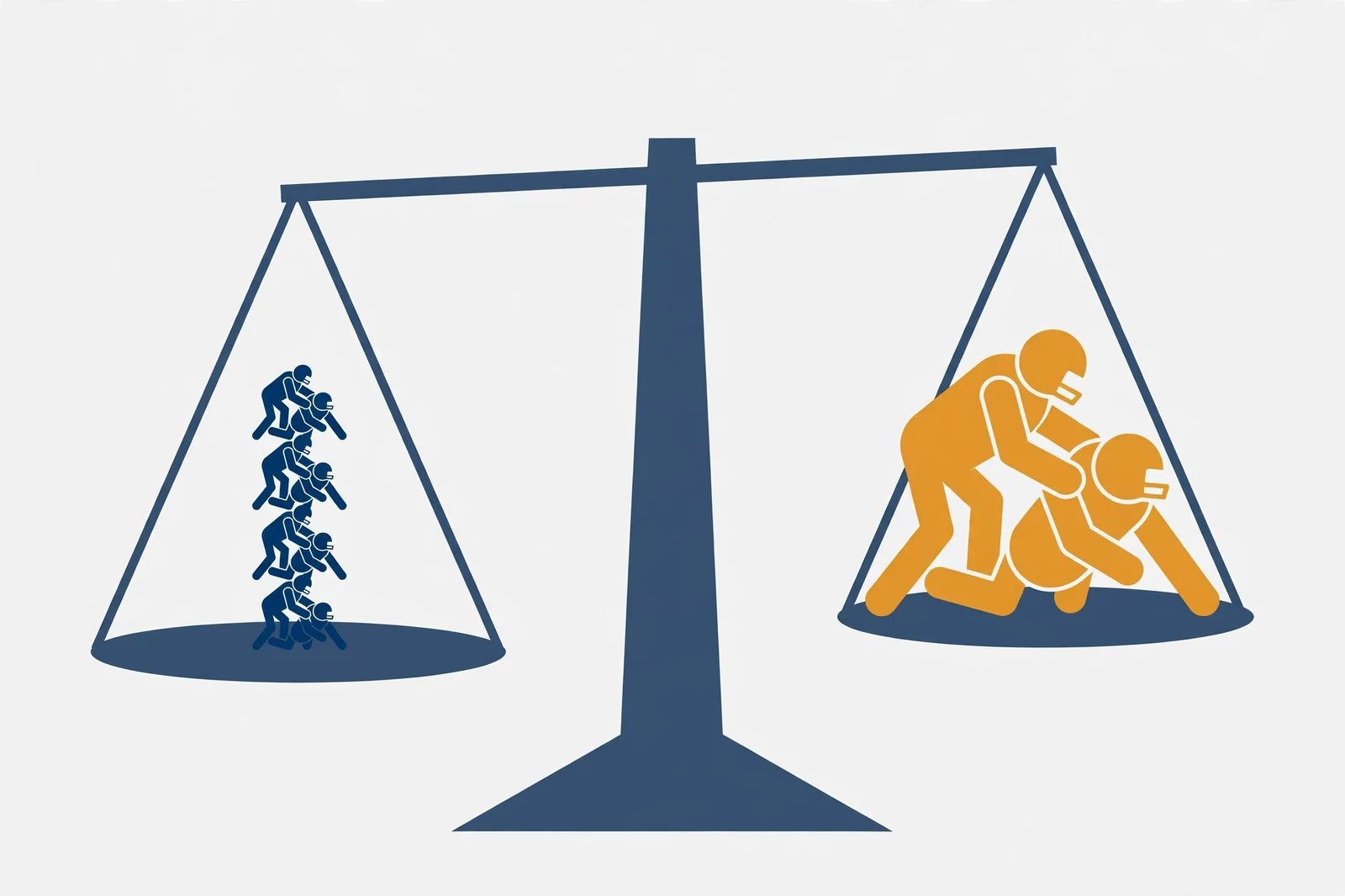
You do not need to study your whole settings page. One division tells you what kind of league you play in. Take the points your league gives for a sack and divide them by the points for a solo tackle. That is your sack-to-tackle ratio.
- Sleeper default: a sack is worth 2, a solo tackle 1. 2 ÷ 1 = 2.0.
- ESPN default: a sack is worth 4, a solo tackle 1. 4 ÷ 1 = 4.0.
As a guide used by FootballGuys in their IDP work: under 2.5, your league is tackle-heavy. Around 3, it sits in the balanced middle. At 5.0 or higher, it is big-play heavy. So the Sleeper default leans tackle-heavy, and the ESPN default leans toward big plays — before your commissioner changes a single setting.
💡 Try It Now
Open your league settings, find the sack and solo tackle values, and divide. Thirty seconds. You will know your system before you finish this article.
The Three Systems Everyone Uses
Commissioners rarely build scoring from scratch. Most copy one of three published systems, or start from a platform default that already follows one. These are the three names you will see in rankings and articles.
| Play | IDP123 | Big 3 | FantasyPros |
|---|---|---|---|
| Solo tackle | 2 | 1.25 | 1.5 |
| Assisted tackle | 1 | 0.75 | 0.75 |
| Tackle for loss | 2 | 3 | 2.5 |
| Sack | 6 | 5 | 4 |
| Forced fumble | 3 | 4 | 4 |
| Fumble recovery | 3 | 3 | 4 |
| Interception | 6 | 6 | 5 |
| Pass defended | 3 | 4 | 1.5 |
Read the pattern, not just the numbers. IDP123 pays the most for steady work — full value for tackles, and a strong 6 for sacks and interceptions. Big 3 trims the tackle values and pushes the splash plays up: a pass defended pays 4 there, more than three solo tackles. FantasyPros sits between them, with a stronger solo tackle than Big 3 and softer pay for passes defended.
None of the three is the "right" system. They reward different defenders, which is exactly why a ranking built on one system misleads you in another.

Platform Defaults: Sleeper vs ESPN vs Yahoo
If your commissioner never touched the settings, you are playing the platform default. The three big platforms agree on more than they disagree on: all three pay 1 for a solo tackle, 0.5 for an assist, 3 for an interception, 2 for a forced fumble or a recovery, 1 for a pass defended and 6 for a defensive touchdown.
The sack is where they split. Sleeper pays 2. Yahoo pays 3. ESPN pays 4. Run the ratio test: Sleeper sits at 2.0, Yahoo at 3.0, ESPN at 4.0. A pass rusher on ESPN scores twice the sack points of the same player on Sleeper, while their tackle points stay identical. Sleeper's default also follows the IDP123 family, which is why so many dynasty leagues feel tackle-heavy even when nobody chose that on purpose.
Tackle-Heavy Leagues: Who Gains, Who Loses
In a tackle-heavy league, points come from volume. The defenders who gain are the ones on the field for every snap, cleaning up plays: off-ball linebackers first, then box safeties who play near the line.
- Gain: linebackers with every-down roles; safeties who tackle in the box; defensive linemen who stop the run.
- Lose: pure edge rushers who finish games with two tackles and no sack; cornerbacks who are rarely targeted.
The swing is not small. In FantasySixPack's published comparison of recent season finishes under different systems, linebacker Jamien Sherwood placed at LB10 with tackle-heavy scoring and LB20 with big-play scoring. Same season, same player — the settings moved him ten spots.
Big-Play Leagues: Who Gains, Who Loses
Big-play scoring flips the board. Sacks, interceptions and turnovers pay so much that one play can beat a linebacker's whole afternoon of tackles.
- Gain: edge rushers and sack artists on the defensive line; ball-hawk safeties and corners who take the ball away.
- Lose: steady tacklers with few splash plays; corners that quarterbacks avoid, because few targets means few chances.
FantasySixPack's same comparison shows defensive back Marcus Jones finishing as the DB1 under big-play scoring and DB26 under tackle-heavy scoring, and defensive lineman Josh Sweat at DL9 in big-play against DL24 in tackle-heavy. A player can be a star in one system and a streamer in the other.
The risk for dynasty managers: big-play value swings hard from year to year. Sack totals jump around, and a pass rusher's price can fall just as fast as it rose. Pay for the role and the talent, not for last season's spike.
Balanced Leagues: The Middle Ground
A balanced league sits between the two, with a sack-to-tackle ratio near 3 to 1. Tackles still pay the weekly bills, and a sack or an interception gives a real boost without deciding the week on its own.
Most published rankings quietly assume something close to balanced. If your ratio test lands near 3, standard rankings will serve you fairly well. The further your league sits from 3 in either direction, the more you should adjust those rankings before you draft or trade.
How Scoring Changes Dynasty Value
In redraft, scoring changes this year's points. In dynasty, it changes prices for years. A 24-year-old linebacker in a tackle-heavy league is a set-and-forget starter whose value barely moves. The same player in a big-play league is a mid-tier piece, because his steady tackles never catch a pass rusher's sack weeks.
How to Pick a System for Your League
If you run a league and the scoring is still yours to set, pick on purpose:
- Decide what you want to reward. Steady defensive play, or the plays that make the highlights? There is no wrong answer — but your league should know which game it is playing.
- Set the ratio first. Solo tackle and sack values decide everything else. Pick your ratio — near 2, 3, or 5 — then fill in the smaller plays.
- Start enough defenders. Scoring cannot save a format where teams start so few IDP spots that good defenders sit on waivers.
- Lock it before the draft, and leave it alone mid-season. Managers build rosters around the scoring. Moving the goalposts after that breaks trust faster than any bad beat.
Copying IDP123, Big 3 or a platform default is fine. Copying one without knowing which kind of league it creates is how commissioners end up with a format nobody wanted.
FAQ
How does IDP scoring work?
You draft individual defenders — linebackers, defensive linemen and defensive backs — and they score for tackles, sacks, turnovers and other defensive plays. Each league sets its own point value for every play, and those values decide which defenders are worth starting.
What is tackle-heavy scoring?
A setup where tackles pay well compared with sacks and turnovers, so high-volume tacklers — mostly linebackers — top the rankings. The quick check is the sack-to-tackle ratio: under 2.5 usually means tackle-heavy.
What is IDP123?
A popular published scoring system. It pays 2 points for a solo tackle, 1 for an assist, 6 for a sack or an interception, and 3 for plays like forced fumbles and passes defended. It rewards steady tackle production more than most systems.
How can I tell if my league is tackle-heavy or big-play?
Divide your league's sack points by its solo tackle points. Under 2.5 points to tackle-heavy, around 3 is balanced, and 5.0 or more is big-play heavy. Sleeper's default (2.0) leans tackle-heavy; ESPN's default (4.0) leans big-play.
Which IDP position is most valuable in a tackle-heavy league?
Linebacker, and it is not close. Linebackers make the most tackles, play the most snaps, and repeat that volume year after year — which is why they anchor IDP rankings in tackle-heavy formats.
Your IDP scoring settings are not fine print. They are the rules that decide what a defender is worth, and a manager who reads them drafts a different defense than the one who does not. Run the ratio test, name your system, and then build for the league you are actually in.
Check a Defender's Value in Your Format
Run any IDP trade through the free Dynasty Trade Calculator with your league's settings, and see how the values move.